
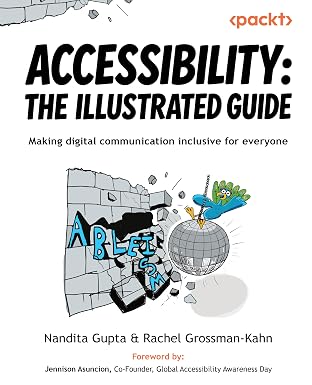
Accessibility: The Illustrated Guide
Making digital communication inclusive for everyone

Author
Nandita Gupta
Accessibility Program Manager at Cisco, CPACC


Author
Rachel Grossman-Kahn
Details
- Print length 148 pages
- Publication date September 9, 2026
- Published by Packt
- Available in Paperback and eBook
Accessibility: The Illustrated Guide comes from Nandita Gupta, an accessibility program manager at Cisco and CPACC, and Rachel Grossman-Kahn, a UX designer who spent a decade as a sign language interpreter for Deaf and DeafBlind communities. The book explains inclusive digital communication through illustration, drawing out concepts that usually reach readers as dense guideline text.
Coverage runs across the everyday material teams actually publish: documents, email, social posts, presentations, and video. At 148 pages it is built to be read in a sitting. The guidance is written for people who are not accessibility specialists but who put content into the world every week, which makes it easy to hand to a marketing team or a program manager who needs to get this right without reading WCAG end to end.
Closing the 2026 list with this title gives the club something to pass outward. It is the book you give a colleague who asks where to start, and it pairs well with the March reading on accessible communications from Lisa Riemers and Matisse Hamel-Nelis.
What this book is
Packt published this as a graphic-format guide to inclusive digital communication. Rather than restating guidelines, it draws them. The recurring cast is a set of animal characters with different disabilities and access needs, including a neurodivergent tech professional panda, a blind owl professor, and a postpartum kangaroo.
The publisher's framing says it plainly: "You don't need to be an accessibility expert to make a difference. You just need to care enough to begin." At 148 pages, Packt estimates about four and a half hours of reading. That makes it the lightest read of the year and an easy one to finish over the holidays.
What it covers
Packt lists six outcomes for readers:
- Making social media posts, email, documents, and presentations accessible
- Writing effective alt text
- Designing inclusive slides
- Hosting meetings and events where everyone can participate
- Communicating respectfully with disabled people, including etiquette and common missteps
- Using AI responsibly when creating accessible content
No table of contents has been published yet. The list above comes from the publisher's product page, not from the book's chapters.
About the authors
Nandita Gupta
Nandita is a product and accessibility leader at Cisco with more than ten years building AI products, and she holds the CPACC credential. She has a bachelor's in electrical engineering and a master's in human-computer interaction. Her work centers on making AI usable for the 1.3 billion people worldwide who have a disability.
She was inducted into the Susan M. Daniels Disability Mentoring Hall of Fame and named to ADCOLOR in Tech in 2024. She has spoken at Grace Hopper Celebration, M-Enabling, and UX Talks Tokyo, and her TEDx talk "Look Within Yourself: Embarking on my Accessibility Journey" was recorded at TEDxGeorgiaTechSalon. She serves on several non-profit boards, including Lime Connect.
Members will recognize her. Nandita was a contributing author on Inclusive Design for Accessibility and joined us for the September 2025 author Q and A.
Rachel Grossman-Kahn
Rachel leads accessibility and inclusive design at a Fortune Top 10 technology company in Seattle, working on Audible at Amazon. She has been in and around the disability community professionally for more than sixteen years, and she is disabled herself.
Before design, she spent a decade as a professional sign language interpreter for d/Deaf and DeafBlind communities, and a few years at Walt Disney Animation Studios. She holds an MS in UX design, a BA in visual arts, and an associate's degree in ASL interpreting. She sits on the Foundation Board of Directors at Lighthouse for the Blind. Earlier project work includes the Assistive Technology Hub for Best Buy and a 5G football helmet built with AT&T for d/Deaf and hard-of-hearing athletes.
Fun facts
- Our mascot is an owl. One of the book's recurring characters is a blind owl professor. Nobody planned this.
- Packt credits no separate illustrator, so who actually drew the book is an open question. Good one to put to the authors.
- At 148 pages this is the shortest book on the 2026 list by a wide margin.
- Rachel's path into accessibility design ran through Walt Disney Animation Studios and a decade of ASL interpreting.
Discussion topics for December
- Illustration as a teaching method. What does a drawing convey that a success criterion cannot, and what gets lost on the way?
- A book taught through pictures raises an obvious question about its own accessibility. How should an illustrated guide handle alt text, described figures, and its ebook edition?
- The AI material. Where does generated content genuinely help accessibility work, and where does it quietly manufacture more remediation?
- Etiquette and missteps. Bring one thing you got wrong early in your career and whatever corrected you.
- Who in your organization would actually read this, and what would you want them doing differently on Monday?
Leave a Review for This Book
Every reader’s perspective adds value. Whether this book challenged you, inspired you, or wasn’t your favorite, we’d love to hear about it. Sharing your honest review helps others find books that resonate. All reviews will be published on the book’s page. Your email will stay private.
Thank you for submitting your review! Once it’s been reviewed by our team, it will be published on the book’s page.
We appreciate your contribution to the Accessibility Book Club community.
Discover the power of knowledge through our featured book.
Each book offers an opportunity to learn from industry leaders in the exploration of digital accessibility principles and practices. The titles serve as a vital resource for professionals seeking to enhance their understanding and implementation of industry standards.
Key Themes
Inclusivity, user experience, and practical strategies for accessible design are all taken into consideration when choosing each book.
Accessibility Highlights
We love books that dive deep into accessibility principles, best practices and teach readers common terminology and techniques.


"Knowledge is power." - Thomas Jefferson
Discover Your Next Read or Suggest One for the List
Explore the curated selection of books on our annual reading list. If you do not see a title you think we should read please let us know. Be apart of our vibrant community to enhance your knowledge and skills in inclusive design.
Join the Book Discussion
We want to know more—share your thoughts and insights with fellow members.

Member Feedback
This is what our members are saying about the club:
It brought me closer to the people who really care for accessibility. The Accessibility Book Club has been an incredible space to share ideas, learn from passionate individuals, and grow as an advocate for inclusive design. I also connected with Manuel, the author of Web Accessibility Cookbook, and had the prestigious opportunity to professionally review his book and learn his inspiring story. As someone deeply inspired by accessible design—especially with my mother being a teacher for students with special needs—this community holds a special place in my heart. 💙


Yash Raj Bharti
UXE (front end) Lead
I love the Accessibility Book Club. The participants bring such good questions, and the Club is so thoughtfully organized. Sometimes we talk about care as a value in disability work in ways that can get unarticulated in the context of more technical work. I found Accessibility Book Club to be a great place for smart conversations done with care about access work. I'm incredibly grateful to have had my book read and discussed by this group. Thank you all!


Ashley Shew
Associate Professor of Science, Technology, and Society
I joined the Accessibility Book Club because accessibility is something I care deeply about, and I wanted to connect with others who truly 'get it.' It’s a space where I can learn, and be part of a community that shares my passion for making an impact.


Dr. Nicole L'Etoile, Ed.D.
Learning Experience Designer
I was overwhelmed when I clicked the Zoom link and saw a full screen with faces looking at me. All these people decided to spend time with me and ask questions about my book and accessibility. That’s an experience I will never forget. The Accessibility Book Club is a unique and invaluable initiative I can wholeheartedly recommend.


Manuel Matuzović
Author Web Accessibility Cookbook
I have always wanted to join a book club and was very happy when I discovered one that was about accessibility! Not only does this book club give us the chance to learn more, it also gives us a platform to connect with people passionate about accessibility.


Amber Wilson
Founder & CEO
I joined the Accessibility Book Club after hearing my advisor speak about her book, and I’ve been inspired by the opportunity to discover what this incredible community is reading in the ever-evolving world of accessibility.

Sonal Sathe
Doctoral Student
I recommended the Accessibility Book Club to my daughter, an aspiring UI/UX designer, so she could connect with a community of professionals and access the wealth of knowledge in the books we’re reading. This group isn’t just helping her education—it’s setting her up to be a standout candidate in her future career.

Dana McMullen
Digital Accessibility Trusted Tester and Consultant