
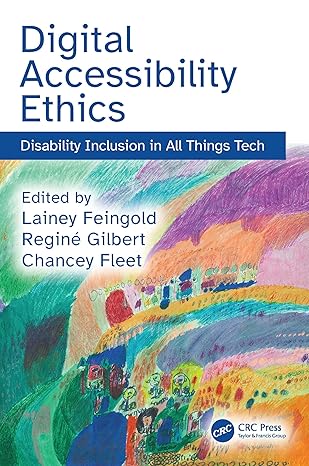
Digital Accessibility Ethics
Disability Inclusion in All Things Tech

Author
Details
- Print length 368 pages
- Release Day May 6th, 2026
- Available in Hardcover, Paperback and eBook
- 39 Total Authors
Digital Accessibility Ethics is a multi‑author collection that argues digital accessibility is fundamentally an ethics issue, not just a technical or legal one. Edited by Lainey Feingold, Reginé Gilbert, and Chancey Fleet, the book gathers 30‑plus chapters from 30+ authors across 10 countries and one commonwealth, most of whom are disabled. Together they bring more than 600 years of combined accessibility and disability advocacy experience.
At the heart of the book is the Digital Accessibility Ethics Framework — an action‑oriented tool that helps organisations examine their products, policies, and AI systems through three lenses: values, actions, and questions. The chapters apply this framework to real‑world topics including AI and machine learning, global legal landscapes, gaming, smart cities, overlays, procurement, cybersecurity, open source, publishing, healthcare, higher education, audio description, and accessibility practitioner burnout.
This is essential reading for leaders, policymakers, designers, developers, researchers, educators, and anyone influencing digital technology. It’s especially suited to book‑club style reading because each chapter stands alone yet contributes to a bigger conversation: who is harmed when accessibility is ignored, and what does an ethical, disability‑centered tech future look like?
Introduction – The digital accessibility gap and why an ethics framework is needed
(author not specified in the ToC; very likely the editors as a group)
Section One – Foundation
- Chapter 1 – Overview of the Digital Accessibility Ethics framework
Lainey Feingold, Reginé Gilbert & Chancey Fleet - Chapter 2 – Core concepts: disability and accessibility in this collection
Crystal Preston‑Watson - Chapter 3 – Ethical dilemmas created by artificial intelligence
Jutta Treviranus - Chapter 4 – Global legal landscape for digital accessibility
Lainey Feingold
Section Two – Ethical Accessibility Practices
- Chapter 5 – “Designing with”: expanding disabled people’s power in design
Josh Kim - Chapter 6 – Building ethical accessibility into development workflows
Léonie Watson - Chapter 7 – Accessibility leadership ethics in India and worldwide
Shilpi Kapoor - Chapter 8 – Cognitive accessibility and empowering all minds
Margaux Joffe - Chapter 9 – “Don’t buy broken things”: ethical accessible procurement
Sheri Byrne‑Haber - Chapter 10 – Hackathons, student projects and accessibility ethics
Joshua A. Miele - Chapter 11 – Deaf leadership and ethical hiring in science and tech
Jenny C. Lu & Sheila Xu - Chapter 12 – Ethics of voice recognition and voice tech accessibility
Meenakshi Das - Chapter 13 – Digital accessibility ethics across Africa: progress & challenges
Irene Mbari‑Kirika & Dr. Samuel Kabue - Chapter 14 – Ethics of describing visual content and the visual world
Nefertiti Matos Olivares & Thomas Reid - Chapter 15 – Facial difference, AI bias and accessibility ethics
Carly Findlay - Chapter 16 – “Everyone Needs (At Least a Little) Accessibility Education”
Rolando J. Méndez Fernández & Kate Sonka - Chapter 17 – Accessibility overlays and the harms of “quick‑fix” marketing
Adrian A. Roselli - Chapter 18 – Accessibility practitioner burnout as an ethics issue
Matt May
Section Three – Digital Accessibility Ethics Across Sectors
- Chapter 19 – Emergency preparedness with digital accessibility ethics
Erin E. Brown - Chapter 20 – Delivery robots, guide dogs and accessible emerging tech
Haben Girma - Chapter 21 – Cybersecurity that is secure and accessible by default
Aliyu G. Yisa & Justin Merhoff - Chapter 22 – Digital accessibility ethics in healthcare from both sides
Heidi Joshi, PsyD & Dr. Oluwaferanmi O. Okanlami - Chapter 23 – Smart cities and ethical strategies for inclusion
Mónica Duhem, Josefina Ocampo Guchea & James Thurston - Chapter 24 – AI‑driven workplace tools and disability discrimination
Ariana H. Aboulafia - Chapter 25 – Reading, publishing and digital accessibility ethics
Laura Brady & Daniella Levy‑Pinto - Chapter 26 – Accessible democracy and voting for disabled people
Jess Moore‑Mathews - Chapter 27 – Why open source and digital accessibility need each other
Mike Gifford - Chapter 28 – Immersive tech (XR, etc.) and accessibility ethics
Reginé Gilbert - Chapter 29 – PR, marketing, accessibility and ethical practice
Victoria Ottah Nnenna - Chapter 30 – Game accessibility futures grounded in ethics
Aderyn Thompson - Chapter 31 – Public digital amenities and accessibility ethics
Chancey Fleet - Chapter 32 – Legal ethics, access to justice and digital accessibility
Lainey Feingold
Conclusion – “What’s Next for Digital Accessibility Ethics?”
(Conclusion title from publisher ToC; author not explicitly listed, likely one or more editors)
2. All 39 authors (including editors)
Based on the Ethics Book Editors and Authors page on Lainey Feingold’s site and the Routledge table of contents, these are the 39 named authors (editors + contributors).
Editors (who also author chapters)
- Lainey Feingold
- Reginé Gilbert
- Chancey Fleet
Contributing authors (alphabetical by first name)
- Aderyn Thompson
- Adrian A. Roselli
- Aliyu G. Yisa
- Ariana H. Aboulafia
- Carly Findlay
- Crystal Preston‑Watson
- Daniella Levy‑Pinto
- Dr. Heidi Joshi, PsyD
- Dr. Oluwaferanmi O. Okanlami
- Dr. Samuel Kabue
- Erin E. Brown
- Haben Girma
- Irene Mbari‑Kirika
- James Thurston
- Jenny C. Lu
- Jess Moore‑Mathews
- Joshua A. Miele
- Justin Merhoff
- Kate Sonka
- Léonie Watson
- Laura Brady
- Margaux Joffe
- Matt May
- Meenakshi Das
- Mike Gifford
- Mónica Duhem
- Nefertiti Matos Olivares
- Rolando J. Méndez Fernández
- Sheri Byrne‑Haber
- Sheila Xu
- Shilpi Kapoor
- Thomas Reid
- Victoria Ottah Nnenna
(That’s 36 contributors + 3 editors = 39 authors total.)
Leave a Review for This Book
Every reader’s perspective adds value. Whether this book challenged you, inspired you, or wasn’t your favorite, we’d love to hear about it. Sharing your honest review helps others find books that resonate. All reviews will be published on the book’s page. Your email will stay private.
Thank you for submitting your review! Once it’s been reviewed by our team, it will be published on the book’s page.
We appreciate your contribution to the Accessibility Book Club community.
Discover the power of knowledge through our featured book.
Each book offers an opportunity to learn from industry leaders in the exploration of digital accessibility principles and practices. The titles serve as a vital resource for professionals seeking to enhance their understanding and implementation of industry standards.
Key Themes
Inclusivity, user experience, and practical strategies for accessible design are all taken into consideration when choosing each book.
Accessibility Highlights
We love books that dive deep into accessibility principles, best practices and teach readers common terminology and techniques.


"Knowledge is power." - Thomas Jefferson
Discover Your Next Read or Suggest One for the List
Explore the curated selection of books on our annual reading list. If you do not see a title you think we should read please let us know. Be apart of our vibrant community to enhance your knowledge and skills in inclusive design.
Join the Book Discussion
We want to know more—share your thoughts and insights with fellow members.

Member Feedback
This is what our members are saying about the club:
It brought me closer to the people who really care for accessibility. The Accessibility Book Club has been an incredible space to share ideas, learn from passionate individuals, and grow as an advocate for inclusive design. I also connected with Manuel, the author of Web Accessibility Cookbook, and had the prestigious opportunity to professionally review his book and learn his inspiring story. As someone deeply inspired by accessible design—especially with my mother being a teacher for students with special needs—this community holds a special place in my heart. 💙


Yash Raj Bharti
UXE (front end) Lead
I love the Accessibility Book Club. The participants bring such good questions, and the Club is so thoughtfully organized. Sometimes we talk about care as a value in disability work in ways that can get unarticulated in the context of more technical work. I found Accessibility Book Club to be a great place for smart conversations done with care about access work. I'm incredibly grateful to have had my book read and discussed by this group. Thank you all!


Ashley Shew
Associate Professor of Science, Technology, and Society
I joined the Accessibility Book Club because accessibility is something I care deeply about, and I wanted to connect with others who truly 'get it.' It’s a space where I can learn, and be part of a community that shares my passion for making an impact.


Dr. Nicole L'Etoile, Ed.D.
Learning Experience Designer
I was overwhelmed when I clicked the Zoom link and saw a full screen with faces looking at me. All these people decided to spend time with me and ask questions about my book and accessibility. That’s an experience I will never forget. The Accessibility Book Club is a unique and invaluable initiative I can wholeheartedly recommend.


Manuel Matuzović
Author Web Accessibility Cookbook
I have always wanted to join a book club and was very happy when I discovered one that was about accessibility! Not only does this book club give us the chance to learn more, it also gives us a platform to connect with people passionate about accessibility.


Amber Wilson
Founder & CEO
I joined the Accessibility Book Club after hearing my advisor speak about her book, and I’ve been inspired by the opportunity to discover what this incredible community is reading in the ever-evolving world of accessibility.

Sonal Sathe
Doctoral Student
I recommended the Accessibility Book Club to my daughter, an aspiring UI/UX designer, so she could connect with a community of professionals and access the wealth of knowledge in the books we’re reading. This group isn’t just helping her education—it’s setting her up to be a standout candidate in her future career.

Dana McMullen
Digital Accessibility Trusted Tester and Consultant