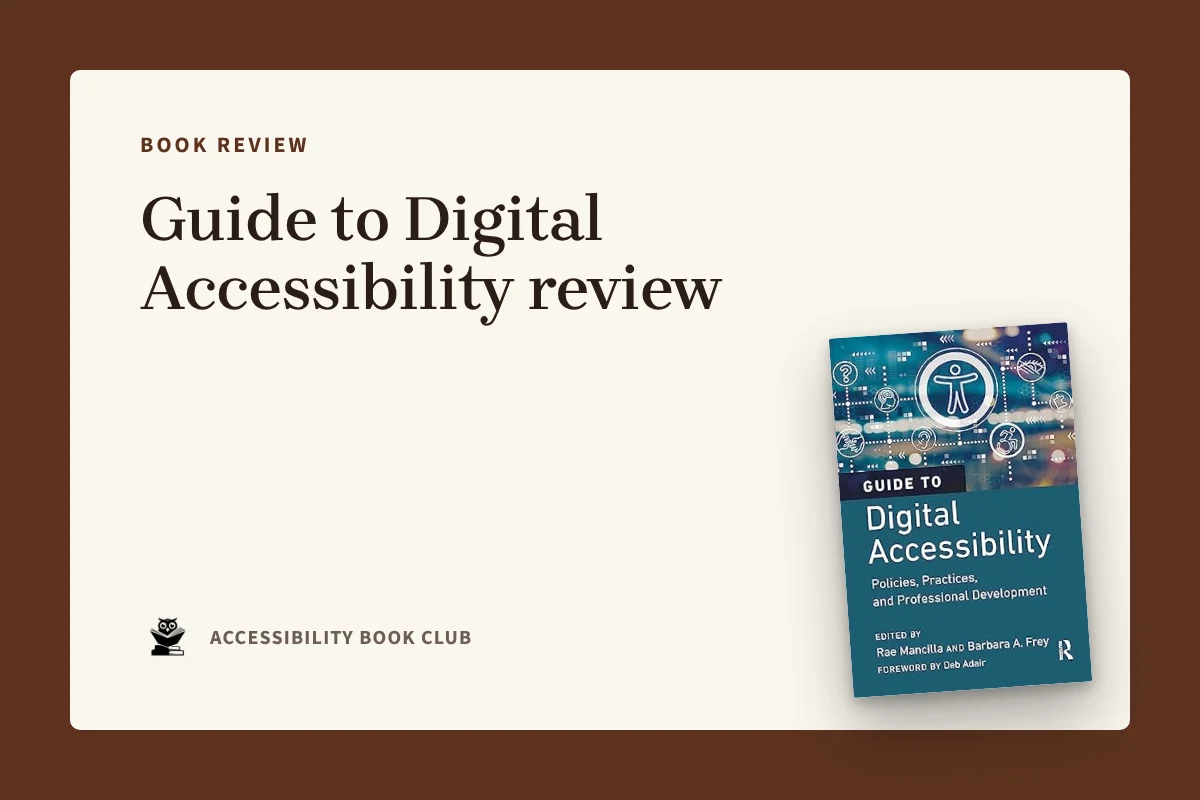
As we wrapped up April 2025, it was time to share my final thoughts on our book club pick, Guide to Digital Accessibility: Policies, Practices, and Professional Development by Rae Mancilla and Barbara A. Frey.
My rating: 7 out of 10
This is a research-driven, highly detailed resource with meaningful insight into building accessibility programs, particularly in higher education. See the full book details on our Guide to Digital Accessibility book page.
A goldmine for higher education
For professionals working in universities, instructional design, or digital accessibility policy, this book is a goldmine of structured strategies, case studies, and frameworks. It shows how to move from ad hoc accommodations to intentional, proactive accessibility. The W3C's guidance on planning and managing web accessibility (opens in a new tab) is a helpful companion for anyone building a program.
Why I took off three points
The content was very dense and heavily academic, which made it harder to get through in a single month, especially while I was launching my business. The writing is formal, and it is best suited for people working on accessibility inside educational institutions.
Chapter 15: the tools I love
I appreciated many of the topics, tools, and frameworks, especially Chapter 15 on technology tools. I was glad to see my favorite tool highlighted alongside other great resources:
- TPGi Colour Contrast Analyser (opens in a new tab)
- The Coblis Color Blindness Simulator
- WebAIM's WAVE evaluation tool (opens in a new tab)
- Microsoft's built-in accessibility checkers
These practical tools are vital for anyone building accessible content, in any industry. For more on contrast, read our post on color contrast as a core accessibility area.
A meaningful meeting
Thank you to everyone who joined our April meeting, even though our author was unable to attend. Life happens. It was still a meaningful discussion, and I am grateful to our community for showing up.
Join the conversation
Are you building an accessibility program in education or elsewhere? What from this guide helped you most? Share your thoughts in the Accessibility Book Club LinkedIn group (opens in a new tab).
Author

Crystal Scott, CPWA
Web Accessibility Engineer